The Untold Stories of the Canadian West Behind My Paintings

People often see a finished painting and assume that's the whole story — a pretty mountain scene, a nice animal, a nice sky. But almost every piece I make starts somewhere else entirely: a question I couldn't stop thinking about, a piece of history I stumbled onto, a feeling I had standing in a specific spot at a specific time of day.
I wanted to pull back the curtain on three paintings and tell you what's actually underneath them — the history, the symbolism, and the personal reasons they exist at all.
This painting shows a sunrise over the Three Sisters in Canmore, with a teepee standing at the center of the scene.
Before this valley was a town, it was a place people came to for ceremony and healing. That's not a detail I added for atmosphere — it's part of the actual history of this land, and it's something I think about every time I'm out here watching the light change on these peaks. Some places just hold a kind of energy that doesn't go away no matter how much changes around them, and I think this valley is one of them.
I painted it in fall on purpose. Fall isn't really an ending — it's a transition. The long days of summer start giving way to longer nights, and there's this natural pull toward reflection, toward gratitude for what the season gave you. The trees go through their own version of it too: green, then yellow, then orange, like they're dressing for the occasion before they finally let go and face winter.
And through all of that change, the sun still rises every morning over Mount Lawrence Grassi, Miner's Peak, Ha Ling, and the Rundle range — the same eternal rhythm, regardless of the season or the century. That contrast between constant change and constant return is really what this piece is about.
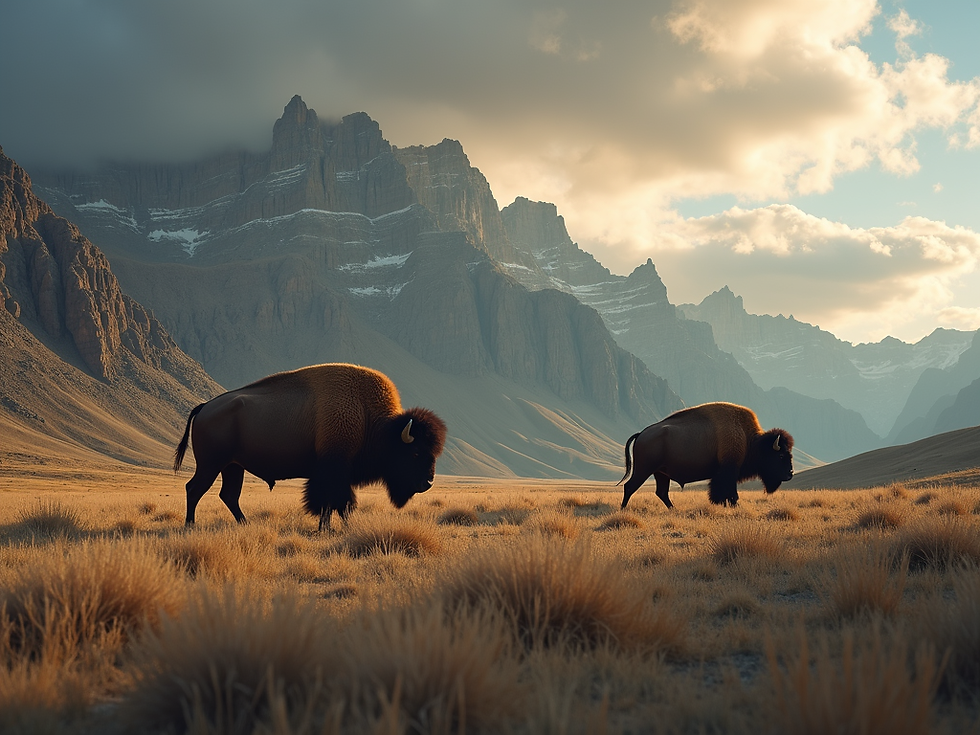
This one shows a golden sunrise over the Canmore mountains, with a bison herd roaming a wide grassy plain, and one bison standing alone at the front of the painting.
I've always been a bit obsessed with the history of the places I live in — not just what they look like now, but what they used to look like. When I first arrived in the Bow Valley and saw all these young forests, something clicked: this landscape hasn't always looked the way it does today.
This valley was carved by glaciers a very long time ago, and for millennia it was prime wildlife habitat. Bison roamed here in massive herds, and their presence likely kept much of the valley floor as grassland rather than forest. The native people of this land lived alongside these animals for generations, in a relationship that shaped both the land and their way of life.
The bison that once grazed right here, surrounded by Miner's Peak and Ha Ling, watched the exact same sunrise we still get to see today — just from a completely different chapter of this valley's story. The mountains haven't moved. They've simply stood there, witnessing all of it.
That's the part that gets me every time I paint mountains: they're not just scenery. They're witnesses.
The last piece is quieter and more direct — a half-portrait of a bison's face, rendered in dusty blue tones. The title is "Here I Am."
When I first moved to Canada, the bison kept coming to mind in a way I couldn't fully explain — almost like a memory from somewhere I couldn't place. The more I learned, the more that feeling made sense: bison were once hunted to the edge of disappearing entirely from this continent. And yet they didn't disappear.
This painting is my attempt to capture the look of the last bison of the Rockies — that specific moment when everyone assumed they were gone, and the animal was still standing there anyway. Not defiant exactly. Just present. Still here.
That's the symbolism I was reaching for with this one: resilience that doesn't announce itself, it just persists. I think a lot of us recognize that feeling in our own lives too, which might be part of why this piece tends to stop people in their tracks.
Why I Keep Painting This Way
I could paint a mountain because it's pretty — and sometimes I do. But the pieces that mean the most to me, and seem to mean the most to the people who end up bringing them home, are the ones with a real story underneath the paint. A history. A reason.
When you understand what's actually behind a piece — the land's past, the symbolism, the moment that sparked it — it stops being decoration and starts being something closer to a window into a specific place or a specific emotion.
That's really what I'm trying to do with each one: paint the West not just as it looks, but as it remembers.


Comments